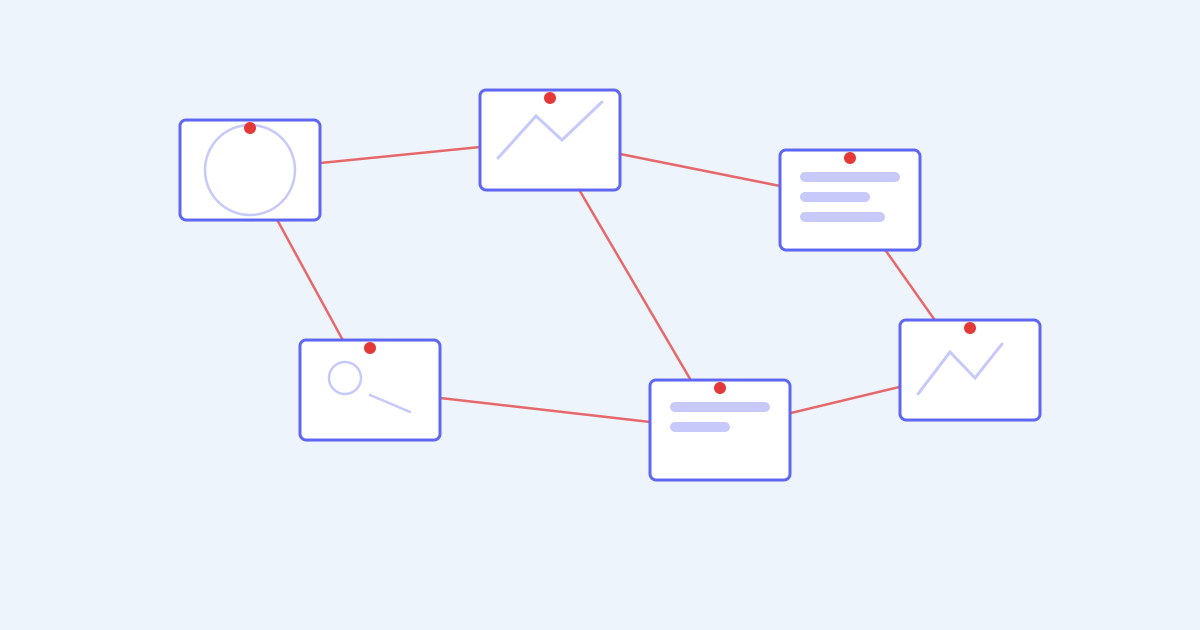
If you've watched any detective show or crime thriller in the last few decades, you know the scene: a wall covered in photos, newspaper clippings, and handwritten notes, all connected by lengths of red string. It's such reliable shorthand for 'this character is onto something' that it's become a bit of a joke in its own right. But the cork board and string isn't just a dramatic prop - it's a real investigative technique, and it works for the same reason a concept map does.
A real investigative technique
The trope has a name: it's an evidence board, also known as a conspiracy board, crazy wall, or murder map, and it shows up in everything from The Bridge and Fargo to Sherlock and True Detective. Real investigators use a version of it too, usually less theatrically. It's a form of link analysis: a technique for mapping the connections between people, places, events, and evidence, so that patterns which wouldn't be obvious in a written case file become visible at a glance. Law enforcement agencies have used variations of it for decades to track networks of suspects too large to hold in memory.
Why it works on screen (and off it)
Part of why the trope endures is that it's a genuinely useful way to think, not just a good-looking set piece. As we've written about before, our brains are wired to think spatially, and an evidence board is spatial thinking taken to its logical extreme. Every photo is a node. Every piece of string is a connector. Position on the wall carries meaning - suspects cluster near their known associates, a key piece of evidence sits at the centre with lines radiating out from it. None of that structure could survive being flattened into a list of case notes, but on the wall, the shape of the investigation is the investigation.
It also mirrors how a real detective's thinking actually develops. Nobody starts with the full picture. A name gets added, then a photo, then a line connecting it to something already on the board, then a question mark next to a connection nobody's confirmed yet. The board grows and reorganises as understanding grows, rather than being written once and left alone.
Not just for solving murders
You don't need a murder to solve for this to be useful. Most complex problems, from tracing the cause of a recurring bug to untangling who-said-what in a stakeholder disagreement, have the same shape as a detective's case: a scattered set of facts, some of them relevant and some of them red herrings, with relationships between them that only become clear once you can see them all at once. Plenty of wicked problems that have nothing to do with crime still benefit from exactly this treatment - laying everything out, and drawing the connections as you find them, rather than trying to hold it all in your head or bury it in a document nobody will reread.
Bringing the cork board to Concept Mapper
This is essentially what Concept Mapper is built to do, minus the string and the pushpins. Nodes take the place of photos and index cards, and you can attach an image directly to a node if a picture genuinely matters to the case, rather than describing it in text. Connectors take the place of the string, and unlike string on a real wall, they can carry labels, so a line doesn't just show that two things are related, it can say how. The canvas gives you the same freedom to position things spatially, cluster related evidence together, and keep restructuring the board as your understanding of the problem changes.
The next time you see a character step back from a wall covered in string and finally spot the connection they'd been missing, that satisfying click is the whole point of visual thinking. You don't need a case file to get the same benefit - just a problem worth mapping out.